
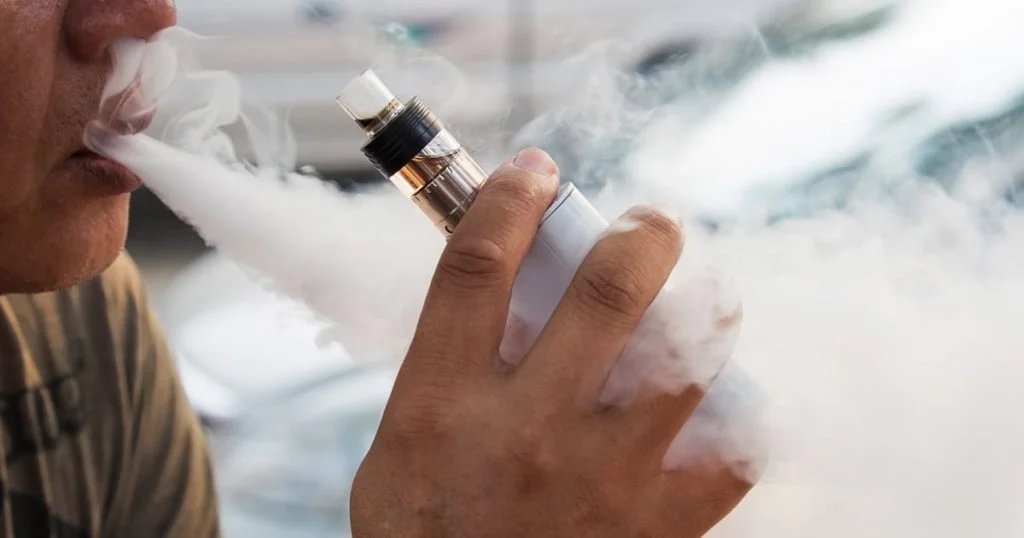
Under the same smoking conditions, the particle sizes of 10 brands of electronic cigarettes are distributed in the range of 10~70nm, and the particle number concentration per unit volume is between 1.08×10⁷~6.27×10⁷·cm-3. The aerosol particle sizes are smaller than those of traditional cigarettes.
The chemical composition of e-cigarette aerosol is relatively complex, mainly including the following seven aspects.
Nicotine and secondary alkaloids. Nicotine is one of the main components of e-cigarette aerosol. In 2014, Goniewicz et al. [30] studied the e-cigarettes that are popular in the UK market and found that the atomization efficiency of nicotine is about 10% to 81%. For every 300 puffs of e-cigarettes, the nicotine release amount ranges from 2 to 15 mg. The delivery efficiency of nicotine from e-cigarette liquid to the human body is related to the nicotine content in the liquid, the atomization efficiency and the bioavailability. The higher the three, the higher the delivery efficiency [31]. The degradation products of nicotine are secondary alkaloids. Some studies have found that secondary alkaloids have been detected in e-cigarette aerosols containing nicotine [32].
Carbonyl compounds. There are literature reports on the detection of carbonyl compounds in e-cigarette aerosols [33-34]. Uchiyama et al. [35] tested 363 e-cigarette aerosols from 13 brands, among which formaldehyde, acetaldehyde, acrolein, glyoxal and methylglyoxal were detected. Carbonyl compounds were detected in samples from 9 of the 13 brands. Studies in the United States have shown that the formaldehyde content in e-cigarette aerosols is related to the power of the e-cigarette, and the higher the power, the higher the formaldehyde release in the aerosol, even exceeding that of traditional cigarettes [36].
Glycerin and propylene glycol. Glycerin, propylene glycol or a mixture of the two generally account for about 90% of the mass of e-cigarette liquid, and their proportion in e-cigarette aerosol is also high. Pellegrino et al. [37] found that the proportion of 1,2-propylene glycol and glycerol in e-cigarette aerosol is similar to their proportion in liquid. In addition, some studies have found that aldehydes and ketones may be produced after heating glycerin and propylene glycol [38].
Volatile and semi-volatile organic compounds. The aerosols produced by substances such as flavors and tobacco extracts added to e-cigarette liquids may contain volatile and semi-volatile organic compounds [39]. Laugesen et al. [40] detected p, m-xylene, propylene glycol, styrene and other substances in e-cigarette aerosols. Goniewicz et al. [41] tested 12 types of e-cigarette aerosols. For every 150 puffs of e-cigarettes, the toluene release ranged from 0.2 to 6.3 μg, and the p-(m-)-xylene release ranged from 0.1 to 0.2 μg.
Tobacco-specific nitrosamines (TSNA). Alkaloids in tobacco are nitrosated to form TSNA, which is a strong carcinogen. Goniewicz et al. [41] detected trace concentrations of TSNA in e-cigarette aerosols. There are reports on the analysis of N-nitrosonornicotine, 4-(N-nitrosomethylamino)-1-(3-pyridyl)-1-butanone, N-nitrosoanatabine and N-nitrosoanatabine in e-cigarette aerosols [42-43]. Some studies have found that TSNA in aerosols is a prototype transfer of TSNA in tobacco liquid, and the TSNA content in aerosols can be inferred based on the TSNA content in tobacco liquid [44].
Polycyclic aromatic hydrocarbons and phenolic compounds. There are also reports on the detection of polycyclic aromatic hydrocarbons and phenolic compounds in e-cigarette aerosols. Schober et al. [45] analyzed the levels of e-cigarette pollutants in indoor air after 9 volunteers smoked e-cigarettes in a well-ventilated room for 2 hours and found that the concentration of polycyclic aromatic hydrocarbons that may cause cancer increased by 20%. Wang Chao et al. [46] detected 6 polycyclic aromatic hydrocarbons, including naphthalene, 1-methylnaphthalene, 2-methylnaphthalene, and fluorene, in 13 e-cigarette liquid samples. Cai Junlan et al. [32] summarized the various harmful substances detected in e-cigarette aerosols in a review, including phenolic compounds such as o-cresol, m-cresol, and p-cresol.
Non-metallic elements and metallic elements. Non-metallic elements and metallic elements are not only present in e-cigarette liquids, but may also be present in their aerosols. Goniewicz et al. [41] detected 3 metal elements, cadmium, nickel, and lead, in e-cigarette aerosols. Williams et al. [47] detected the non-metallic element silicon and 20 other metal elements, some of which had aerosol release levels higher than those in traditional cigarette smoke.
1. Medical Background of Atomizers Atomization technology has long been applied in the medical field, particularly in the treatment of respiratory conditions such as asthma and COPD. By converting active compounds into ultra-fine particles, atomizers deliver substances directly to the lungs for rapid absorption and high bioavailability.
August 1st, 20251. Medical Background of Atomizers Atomization technology has long been applied in the medical field, particularly in the treatment of respiratory conditions such as asthma and COPD. By converting active compounds into ultra-fine particles, atomizers deliver substances directly to the lungs for rapid absorption and high bioavailability.
August 1st, 2025Introduction As healthcare providers in the U.S. increasingly seek effective, reimbursable methods to help patients quit smoking, water-based nicotine inhalation products are emerging as a powerful new solution. These formulations offer both clinical effectiveness and regulatory advantages—making them ideal for pharmacy and clinic distribution under Medicare-supported cessation programs. Medicare Covers Up to $2,000 Per Patient […]
July 23rd, 2025Introduction As healthcare providers in the U.S. increasingly seek effective, reimbursable methods to help patients quit smoking, water-based nicotine inhalation products are emerging as a powerful new solution. These formulations offer both clinical effectiveness and regulatory advantages—making them ideal for pharmacy and clinic distribution under Medicare-supported cessation programs. Medicare Covers Up to $2,000 Per Patient […]
July 23rd, 2025Abstract Oil-based cannabinoids have long faced challenges such as low oral bioavailability (typically under 15%), poor formulation compatibility, and inconsistent onset. Water-based delivery systems—THCX, and RENICO—offer a new standard of performance, combining faster absorption, enhanced versatility, and broader consumer appeal. This article outlines the science and innovation behind these next-generation cannabinoid formats. The Limitations of
July 18th, 2025Abstract Oil-based cannabinoids have long faced challenges such as low oral bioavailability (typically under 15%), poor formulation compatibility, and inconsistent onset. Water-based delivery systems—THCX, and RENICO—offer a new standard of performance, combining faster absorption, enhanced versatility, and broader consumer appeal. This article outlines the science and innovation behind these next-generation cannabinoid formats. The Limitations of
July 18th, 2025Abstract Inhalation drug delivery systems have been used in clinical practice for over half a century due to their efficient drug delivery properties. This paper systematically evaluates the pharmacological advantages of portable battery-powered nebulizers as a platform for cannabinoid inhalation. Studies indicate that, compared to traditional oral administration, the inhalation route via nebulization offers significant
July 4th, 2025Abstract Inhalation drug delivery systems have been used in clinical practice for over half a century due to their efficient drug delivery properties. This paper systematically evaluates the pharmacological advantages of portable battery-powered nebulizers as a platform for cannabinoid inhalation. Studies indicate that, compared to traditional oral administration, the inhalation route via nebulization offers significant
July 4th, 2025U.S. marijuana interest groups are sounding the alarm over a House Republican budget proposal that, if passed by Congress, would outright ban marijuana-derived THC products at the federal level, including so-called THCA flower. U.S. Rep. Andy Harris, a Maryland Republican who chairs a key subcommittee on the bill, said the proposal, the Agriculture, Rural Development,
July 6th, 2025U.S. marijuana interest groups are sounding the alarm over a House Republican budget proposal that, if passed by Congress, would outright ban marijuana-derived THC products at the federal level, including so-called THCA flower. U.S. Rep. Andy Harris, a Maryland Republican who chairs a key subcommittee on the bill, said the proposal, the Agriculture, Rural Development,
July 6th, 2025